

A Thoughtful Approach to Artificial Intelligence
Expert TA is bringing AI into teaching and learning intentionally—using leading models, strong instructional safeguards, and meaningful instructor oversight.
- Leading Frontier Models: Expert TA uses leading frontier AI models, surrounded by our own instructional context, safeguards, and reporting.
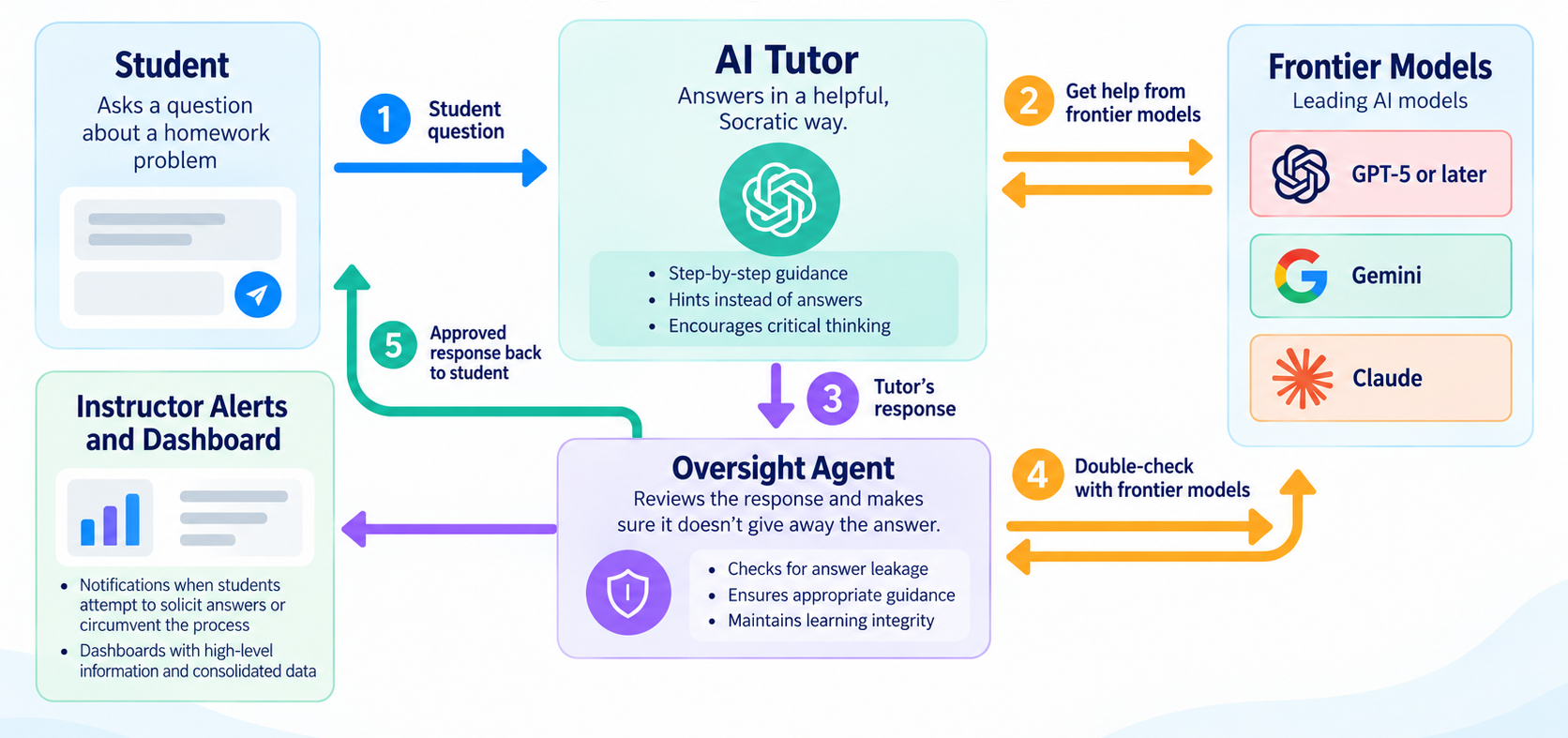
- Appropriate Guardrails: The AI Tutor guides students Socratically, keeps them on task, and avoids simply providing answers. A separate Oversight Agent reviews responses before students see them.
- Instructor Transparency: Instructors can review student–Tutor interactions and see how AI is being used throughout their course.
- Instructor Insights: Student questions are organized around common concepts, difficulties, and misconceptions, helping instructors see where their class needs additional support. Learn More.
- No Additional Cost: The AI Tutor is included at no additional cost and is designed to support regular student use throughout the semester.
- Initial Deployment: Phase I brings AI tutoring into assignments and digital course materials while providing instructors with insights from student interactions.
- Assignment-Level Control: Instructors can turn the AI Tutor on or off for individual assignments, giving them control over where and when it is available.
- Our Plans for AI: Future phases will bring Expert TA’s AI-assisted content-development tools to instructors.
Explore More: See how Expert TA’s AI capabilities complement our Online Homework solutions in Physics, Astronomy, Chemistry, Biology, American Government, and more. Or explore how AI can be used with any of 80+ OpenStax titles through Expert TA’s Editable eBooks platform.
Appropriate Guardrails
Frontier AI models are increasingly capable of following detailed instructional directions. Expert TA’s AI Tutor is instructed to guide students Socratically, helping them think through a problem rather than simply providing the answer. It is also instructed to recognize attempts to circumvent that process and to redirect students when conversations move away from the learning task.
But we don’t rely on instructions alone. Before a Tutor response reaches the student, a separate Oversight Agent, using another frontier model, reviews the interaction and checks for issues such as answer leakage or other responses that do not follow the intended instructional approach.
Instructor Transparency
Instructors should never have to guess how their students are using the AI Tutor. Expert TA provides visibility into individual student–Tutor interactions, along with reporting that shows how and where students are using AI throughout the course. This transparency also provides the foundation for the broader Instructor Insights described below.
Instructor Insights
Instructors have long used classroom response systems, such as clickers, to get a quick window into what students understand and where they are struggling. Expert TA’s Instructor Insights provide a similar window while students are working outside the classroom.
As students work through assignments and ask the AI Tutor for help, their questions can reveal the concepts and misconceptions causing difficulty. Expert TA uses AI to organize those interactions into broader themes, helping instructors identify areas where the class may benefit from additional explanation, review, or discussion.
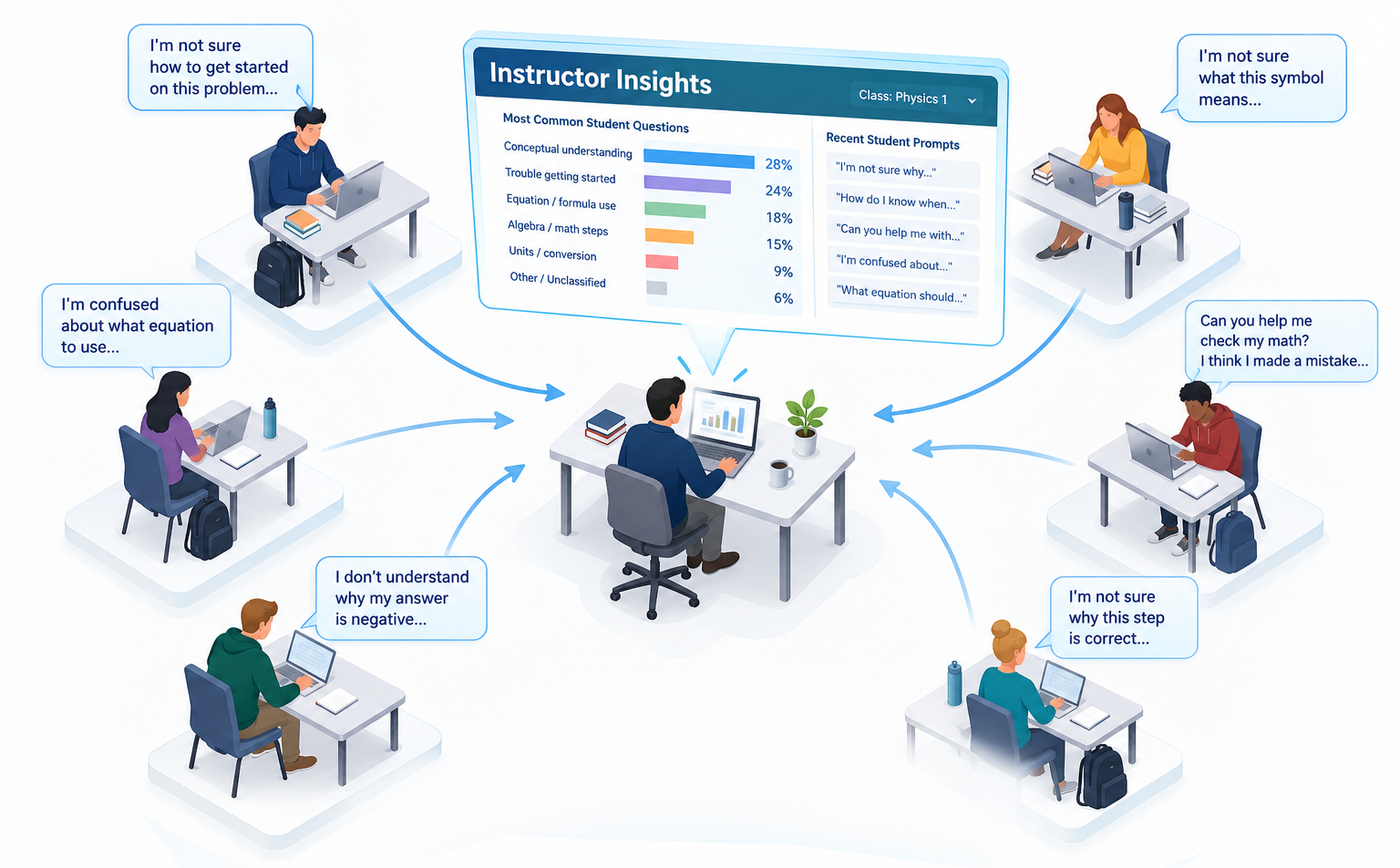
The goal is not simply to know that students asked for help. It is to understand what they needed help with, while there is still time for the instructor to respond.
Turning Student Questions Into Useful Trends
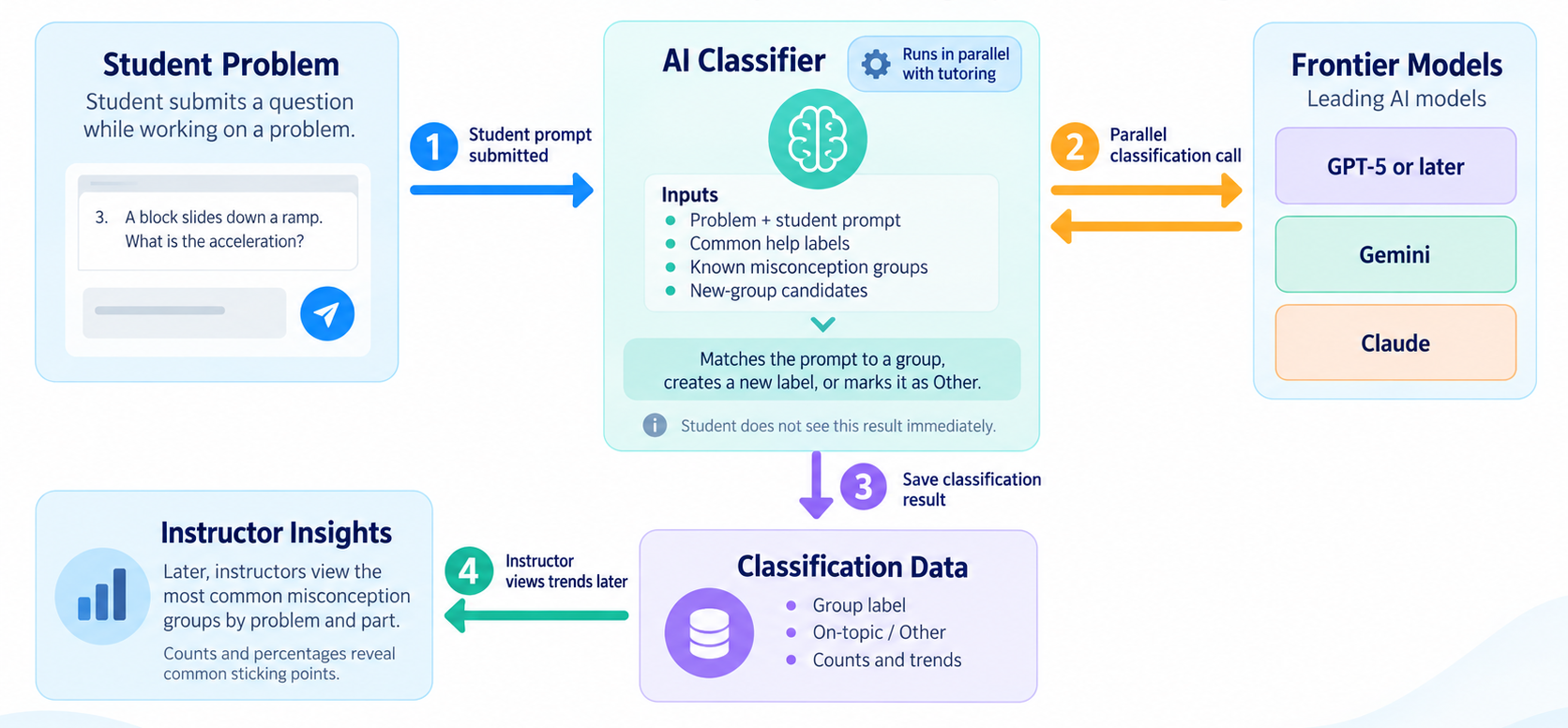
Individual students can ask for help in many different ways, even when they are struggling with the same underlying concept. Expert TA uses AI classification, along with the context of the problem and known misconception groups, to organize these individual questions into broader patterns that instructors can act on.
Better Insights Start with Better Foundations
The quality of these insights also depends on how the known misconception groups are developed. For subjects such as introductory Physics, Chemistry, and Biology, Expert TA begins with well-established curricular frameworks, including those developed by the College Board for AP courses and exams. In Physics, for example, the four AP course and exam descriptions provide more than 800 pages of detailed guidance, including hundreds of Learning Objectives, more than a thousand Essential Knowledge statements, and information about misconceptions observed across a population of more than 300,000 students. Expert TA applies this information to individual questions in our library, providing a strong foundation for identifying and organizing the misconceptions students are likely to encounter.
A Thoughtful, Phased Rollout
Expert TA has spent several years developing and using AI-assisted tools internally for content development and other educational applications. Our student- and instructor-facing rollout builds on that experience and will proceed in phases.
Phase I: AI Tutoring and Instructor Insights
Phase I brings AI assistance directly into the places students are already working. Students can use the AI Tutor while completing assignments and working with Expert TA digital textbooks and instructor-hosted course materials.
At the same time, instructors gain greater transparency and the class-wide insights described above, helping them understand not only where students are asking for help, but what they are struggling with.
Phase II: AI-Assisted Content Development
Phase II will extend AI assistance to instructors. Building on tools Expert TA has already developed and used internally, these capabilities will help instructors create and customize course content more efficiently.
These tools will help instructors:
- author questions for homework, quizzes, and exams;
- create worksheets, in-class activities, and other instructional materials;
- review and revise course notes and instructor-written content; and
- develop or expand customized course materials.
AI can make experienced educators and subject-matter experts substantially more productive while the instructor remains the author, reviewer, and decision-maker.
