
A Thoughtful Approach to AI and Student Privacy
Expert TA believes AI can help students learn without compromising the responsible handling of their information. We have designed our AI Tutor around data minimization, a clear separation of student identity from external AI requests, instructor control, and transparency for students.
Our commitments, at a glance
-
Student identity stays with Expert TA.
Expert TA does not add student names, usernames, or internal student IDs to OpenAI API requests. -
Only relevant learning context is sent.
The model receives a conversation ID, student prompt, activity context, and AI instructions. -
No model training on user data.
Expert TA does not opt in to sharing API inputs or outputs to train OpenAI models. -
Limited data retention by OpenAI.
OpenAI’s standard API may retain requests and responses for up to 30 days for abuse monitoring, not model training. -
Instructors decide when AI is available.
The AI Tutor is off by default and is enabled by instructors. -
Students know when AI is in use.
AI Tutor interactions are identified, and students are reminded that AI can make mistakes. -
Instructor visibility is explained.
Students are informed that instructors can review their Tutor conversations. -
Data ownership and sovereignty are respected.
Students, instructors, and institutions retain their applicable data rights and controls.
Student Identity Stays Within Expert TA
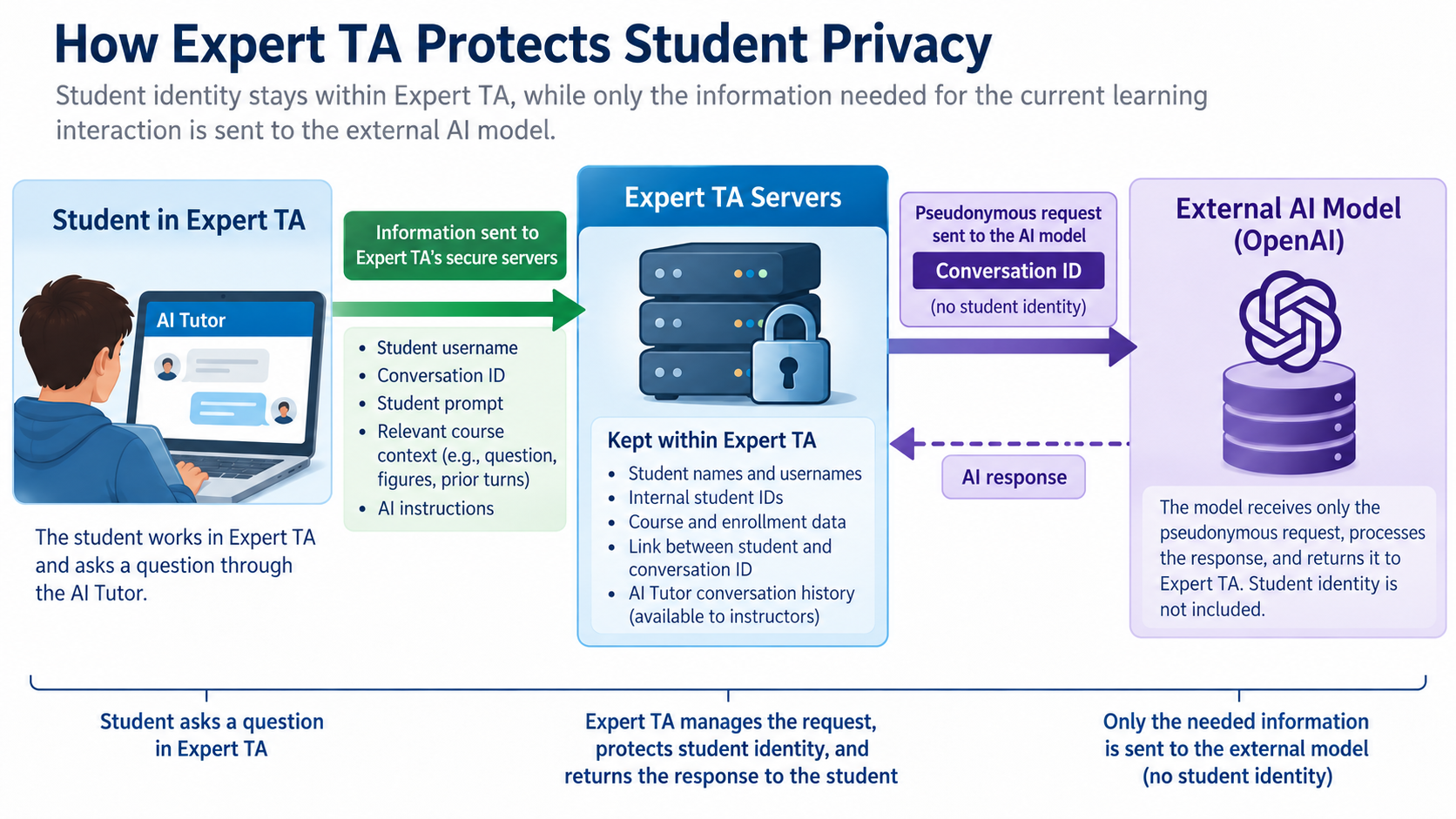
When a student requests help from the AI Tutor, Expert TA processes the request through our own infrastructure. We assign a conversation ID and maintain the association between that ID and the student within Expert TA’s systems. That internal association allows us to return the AI response to the correct student without sending their Expert TA account identity to OpenAI.
Expert TA’s architecture keeps student identity separate from requests to OpenAI. We do not add student names, usernames, internal student IDs, or location information to these requests. Instead, the external model receives a conversation ID and the educational context needed for the current learning interaction.
The key distinction: OpenAI receives the conversation ID, not the Expert TA record that links the ID to a particular student.
What Information Is Shared with the AI?
The AI Tutor needs enough information to understand a student’s question and the course activity they are working on. Expert TA supplies that context while keeping the student’s account identity separate.
Included in an AI request
- A non-identifying conversation ID
- The student’s question or message
- Relevant problem or activity content
- Relevant conversation history, when needed
- Instructions guiding the AI Tutor’s behavior
Not shared by Expert TA as identifying information
- Student name
- Expert TA username
- Internal student or account ID
- Student location information
- The internal conversation-to-student lookup
A note about student-entered text: A student could type personal information into a message. Because that message is sent to the model for processing, we remind students not to include personal or sensitive information in AI Tutor prompts.
Expert TA User Data Is Not Used for OpenAI Model Training
Expert TA connects to OpenAI’s models through its commercial API. Under OpenAI’s published API data policy, neither the information submitted to the API nor the responses generated by the models are used to train or improve OpenAI’s models when the customer has not opted in to data sharing.
Expert TA does not opt in to sharing student, instructor, or institutional information for model training. This commitment applies to user data processed through our OpenAI API integration, not just AI Tutor conversations.
How OpenAI Handles and Retains Data
Expert TA maintains AI Tutor conversation records within our own environment to support the student experience and instructor visibility. This is separate from any temporary retention by an external AI provider.
Expert TA uses OpenAI’s commercial Chat Completions API. Under its standard data controls, request and response content may be retained in abuse-monitoring logs for up to 30 days, subject to OpenAI’s documented exceptions. Ordinary Chat Completions requests are not stored as persistent application state. OpenAI does not use these inputs or outputs to train or improve its models when the customer has not opted in, and Expert TA does not opt in.
Instructor Choice and Transparent AI Use
The AI Tutor is disabled by default. Instructors choose whether to make it available for their students and can control its availability for individual assignments.
When students use the feature, it is clearly presented as the AI Tutor, with information about the model technology being used (for example, GPT-5 or later). Students are told that responses are generated by AI, that AI systems can make mistakes, and that they should avoid sharing personal or sensitive information. This keeps AI assistance explicit rather than blending it invisibly into a conventional help experience.
Instructor Visibility, Data Ownership, and Sovereignty
Instructors can review students’ AI Tutor conversations, helping them understand what questions students are asking and where additional guidance may be useful. Expert TA informs students of this instructor access near the AI Tutor’s conversation interface.
Using Expert TA’s AI features does not change the applicable ownership rights of students, instructors, or institutions in the information and content they provide to Expert TA. Our AI features are intended to support teaching and learning, not transfer ownership of educational data to an AI provider. We also recognize the importance of institutional data sovereignty, including requirements concerning where and how data is processed; any institution-specific commitments should be assessed under the applicable agreements.
Learn More: Explore Expert TA’s AI Tutor & Instructor Insights, or read OpenAI’s API data controls.
